
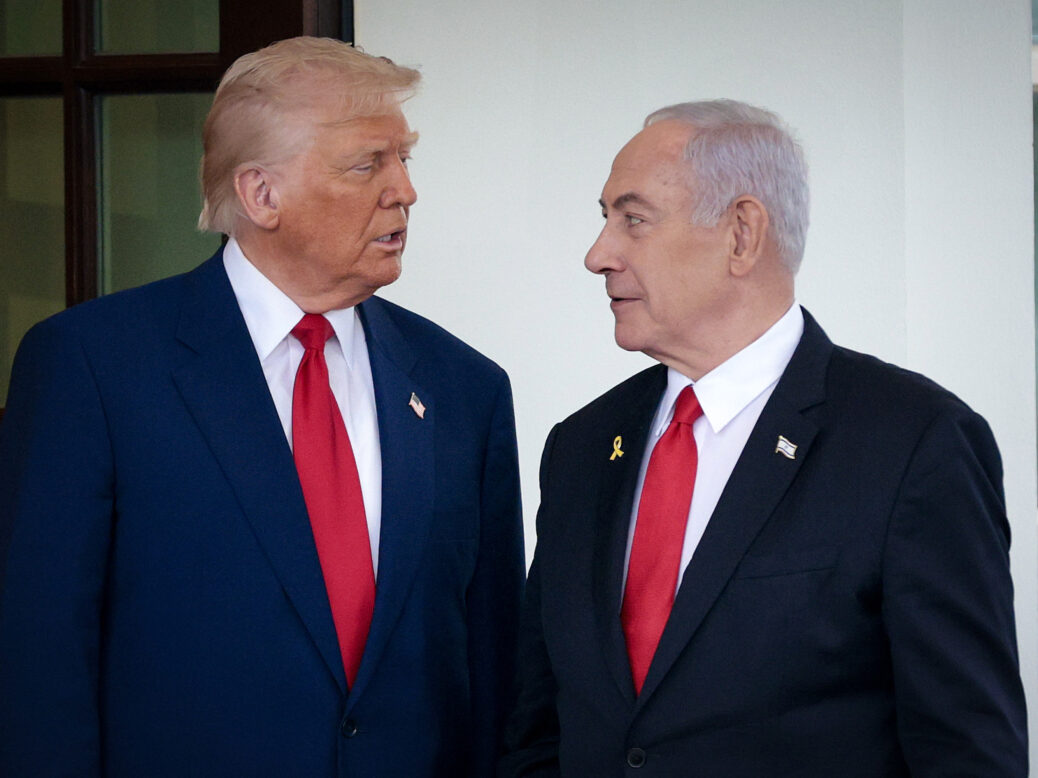
On 11 February, Benjamin Netanyahu walked down the stairs in the West Wing and – this is not usual for a foreign dignitary – straight into the Situation Room.
Inside, he tried to persuade Donald Trump to launch a war against Iran. According to The New York Times, Netanyahu promised the president that they could kill the Supreme Leader, Mossad could foment a popular rebellion and the regime would be too weak to close the Strait of Hormuz. Trump was on board: Operation Epic Fury was launched shortly afterwards. But the war didn’t work out as promised. Forty-one days later, the mullahs are still in control, Iran is charging a toll for ships to pass through the Strait and Israel is waging an increasingly brutal war in Lebanon. In other words, Trump was willingly mis-sold: what was supposed to be another Venezuela looks like an American Suez.
Trump is now trying to extricate himself from this mess. His potential successors, Marco Rubio and JD Vance, were reportedly never keen on the war in the first place, and will want to distance themselves from the fallout. Note that Vance has tried to play a leading role in the ceasefire negotiations. The vice president and the secretary of state – or their teams – likely briefed the Times about their opposition to Epic Fury in order to make it clear that they were sceptical from the start. Rubio reportedly described Israeli intelligence about regime change as “bullshit”.
Eventually, a scapegoat will be needed to blame for this banana skin of a war; Israel increasingly fits the bill. Is this the beginning of the end of the US-Israel partnership as we know it?

The deterioration in the relationship has been going on a long time. One reason is that Israel is simply unpopular. Polls show widespread anti-Israeli sentiment on both sides of the aisle: 60 per cent of Americans now have an unfavourable view of Israel, up from 53 per cent last year and 42 per cent in 2022. In both parties, a majority of those under 50 have a negative view of the country. The future points to a reckoning with the presumption that the US will always be there to protect and arm Israel.
Within the Democratic Party, the Overton window shifted following Israel’s wanton destruction of Gaza after October 7th, which has disgusted many establishment figures, not just far-left activists. Opposing Israel has become a test by which Democrat activists judge the moral rectitude of their leaders. Senator Cory Booker was recently pressed on the popular, centrist Pod Save America podcast about why he wouldn’t call Netanyahu a “war criminal”. Look too at the rise of anti-Israel socialist influencers like Hasan Piker, who was recently campaigning with rising star and Michigan Senate candidate Abdul el-Sayed. Responding on X to the Times’s bombshell report on how Trump war, Bernie Sanders said: “We cannot allow Israel to continue shaping U.S. military and foreign policy”. Opposition to Israel – not restoring trans-Atlanticism, supporting Ukraine or combatting China’s rise – is the predominant foreign policy issue in the Democratic Party ahead of November’s midterms.
On the Maga right, the perception that Israel is manipulating its hapless American ally for its own diabolical ends has gained currency. Twenty-five years ago – even five years ago – support for Israel was as authentically Republican an issue as being pro-life. A shift is currently underway, equal in importance to that happening within the Democratic Party. Vicious anti-Semitism, declining memory of the Holocaust (or even a denial that the Holocaust happened in the way that historians agree that it happened), and a nihilistic meme culture – these are some of the reasons why young Republicans are turning against Israel. But of paramount importance is the belief that Israel exerts genuine and malign influence over US foreign policy in a way that goes directly against the America First agenda. Tucker Carlson, whose future candidacy for the White House looks ever more likely, is pumping out instantly viral criticisms of Israel every day.
For others, the damage done to the relationship is practical: Israel cannot achieve the things it claims it can achieve. One administration official explained to me that the policy Netanyahu had been advocating for decades – regime change in Iran – has failed. Israel, therefore, has lost credibility in the eyes of American foreign policy makers.
But they also cautioned that anti-Israel sentiment within Maga “is confined to a very engaged, very online crowd”. The problem with this argument is that most politics now happens online; and the past decade tells us that the fringe is constantly merging with the mainstream until the mainstream is no longer recognisable. Any observer who spent the past decade studying the fringes of political debate on 4Chan, Tumblr or Twitter would have had a better understanding of what was coming than had they been reading mainstream publications. Even if the most virulent anti-Semitism is confined to the fringes, a new generation with completely different views on Israel will become ever more prominent in American life. Trump has taken US military cooperation with Israel to fresh heights. He has tested the thesis that Israel is a reliable ally and the results have come back negative.
Now, Trump’s ceasefire is breaking down, largely because the Israeli government has continued its bombardment of Lebanon and Hezbollah. The Iranians say the ceasefire covers Lebanon; the US says no such promise was made.
This will only cement the perception that Israel is working against America’s national interests and keeping the country engaged in unwise wars in the region in order to pursue its own course. The two nations have had different war aims from the start. We might look back on Operation Epic Fury as the high water mark of the real special relationship. It could all be downhill from here.
[Further reading: Donald Trump just called time on Nato]
Content from our partners



Related



Join the debate
Subscribe here to commentI sincerely, vehemently, hope this turns out to be true. Let Zionist Israel sink. This diabolical regime needs to go. The U.S. has – on behalf of Israel – tried to disable and impoverish Iran over decades and under Trump the policy just became more explicit and brazen. When a U.S. president calls for the obliteration of a civilisation, there is no hiding behind diplomatic rhetoric. Meanwhile, Europe (aside from Spain) does nothing to cut ties with a blatantly genocidal state because self-interest outweighs morality. History will judge us all for our complicity in the slaughter of innocents.